reading surface
Art and perception
- words
- 3,049
- sections
- 21
- references
- 15
- compendium links
- 57
Art is a way of storing attention in matter. A painting, print, photograph, sculpture, illuminated page, performance, interface, installation, textile, sound work, or designed object records not only an image but also a way of seeing: what was selected, exaggerated, simplified, concealed, made sacred, made strange, made useful, or made durable.
For this compendium, art matters because it connects symbols, design, photography, print, books, music, maps, diagrams, interfaces, ritual objects, archives, and memory systems. It is not decoration after the real work. It is one of the oldest technologies for preserving concepts across time.
The practical definition is broad but not vague: art is a made form that trains perception and carries meaning beyond immediate utility. Some works are sacred, some ornamental, some commercial, some critical, some personal, some computational, and some hard to classify. The compendium should keep those modes visible instead of forcing everything into "beautiful image" or "historical artifact."
Working Definition
Permalink to Working DefinitionArt is both object and relation. A work can be a physical thing, a performance event, a digital file, a set of instructions, a print edition, a site-specific installation, or a cultural memory attached to reproductions. It becomes legible through relationships: maker, patron, workshop, material, place, symbol, school, collection, audience, publication, restoration, criticism, and later reuse.
That makes art a natural bridge between history, semantic web, data sources, and consciousness. Looking is not only passive reception. It is an active cognitive practice: the eye moves, the body orients, memory supplies associations, and the object pushes back through material fact.
Looking Practice
Permalink to Looking PracticeA useful way to look at an artwork is to separate description, form, material, context, and interpretation. What is literally visible? How is attention organized? What materials and techniques were used? Who made it, for whom, and under what conditions? What later meanings have attached to it?
This discipline matters because art writing can drift into vague admiration quickly. Slow looking keeps the claim tied to the object. First describe the visible evidence. Then name the formal structure. Then ask what is known from a collection record, inscription, provenance note, conservation report, catalogue, or scholarly interpretation.
Useful looking questions:
- What is the first thing the work asks the eye to notice?
- What repeats: color, gesture, line, symbol, scale, material, or pose?
- What is absent or deliberately withheld?
- What would change if the work were seen at original scale rather than as a thumbnail?
- Which claims are visible in the object, and which claims come from later records?
Art As Evidence
Permalink to Art As EvidenceAn artwork can be read as image, object, event, commodity, ritual instrument, interface, archive, or memory device. Each mode asks different questions. Image analysis cares about composition and iconography. Material analysis cares about pigment, support, tool marks, edition, repair, and decay. Social history asks who paid for it, who used it, who was excluded from it, and how its meaning changed after circulation.
This is why art is useful in a knowledge graph. A single artwork can link an artist, patron, place, religious symbol, medium, technical process, historical period, collection record, reproduction history, rights status, and later interpretation. The graph should preserve those different relationships instead of flattening everything into "influenced by" or "about."
Art evidence is also fragile. A scan can hide surface, scale, texture, frame, smell, installation context, and the difference between a painting, a print, a facsimile, and a web derivative. Treat digital collection records as powerful access points, not replacements for the object.
Artwork Record Contract
Permalink to Artwork Record ContractA useful artwork record should distinguish:
- work title, alternate titles, translated titles, and title uncertainty;
- creator, workshop, school, publisher, printer, photographer, foundry, or unknown attribution;
- date model: exact date, range, period, edition, state, later copy, or posthumous cast;
- medium, support, dimensions, process, material condition, and display format;
- current collection, accession number, rights status, source image, and stable object URL;
- subject, iconography, symbols, inscriptions, depicted places, and named figures;
- provenance, exhibition history, reproduction history, conservation notes, and interpretive claims;
- public-use status, image license, privacy or cultural-sensitivity constraints, and citation text.
This contract keeps the graph from treating a painting, scan, print, photograph, catalogue record, and web image as the same object. They are related records with different evidence.
Example Records
Permalink to Example RecordsCrucifixion (Corpus Hypercubus) - Salvador Dali
Permalink to Crucifixion (Corpus Hypercubus) - Salvador Dali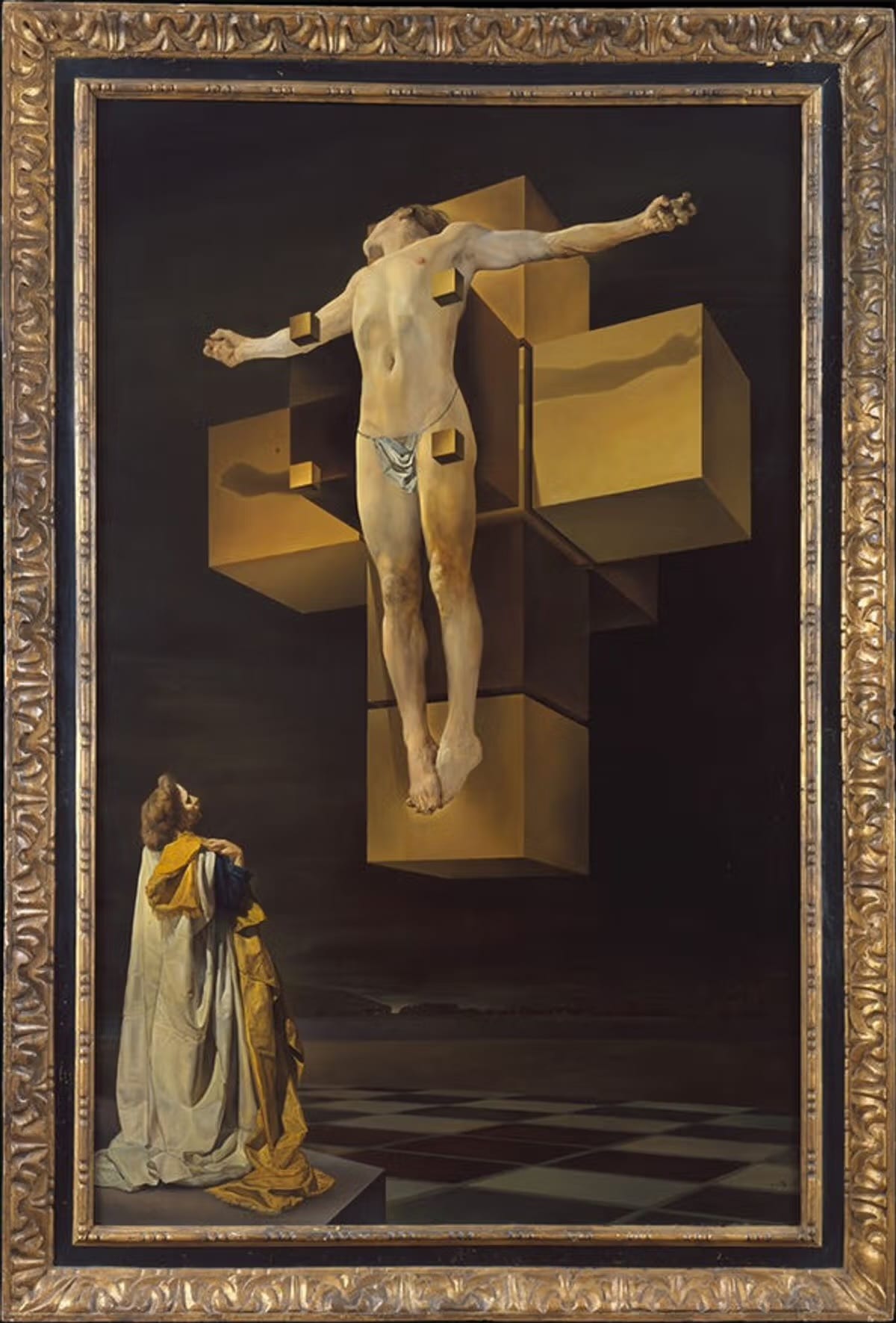
The Met's record for Crucifixion (Corpus Hypercubus) identifies the work as Salvador Dali's 1954 oil-on-canvas painting. It is useful here because it fuses Christian iconography, mathematical form, postwar scientific imagination, and theatrical painting into one object record. The unfolded hypercube is not only a formal trick; it connects the painting to mathematics, symbols, theology, Surrealism, and the history of museum interpretation.
For the graph, this example should not become a loose note called "Dali image." It should be a work node connected to artist, date, medium, collection, object number, subject, geometry, reproduction, local image asset, and interpretive claims.
The Ancient of Days - William Blake
Permalink to The Ancient of Days - William Blake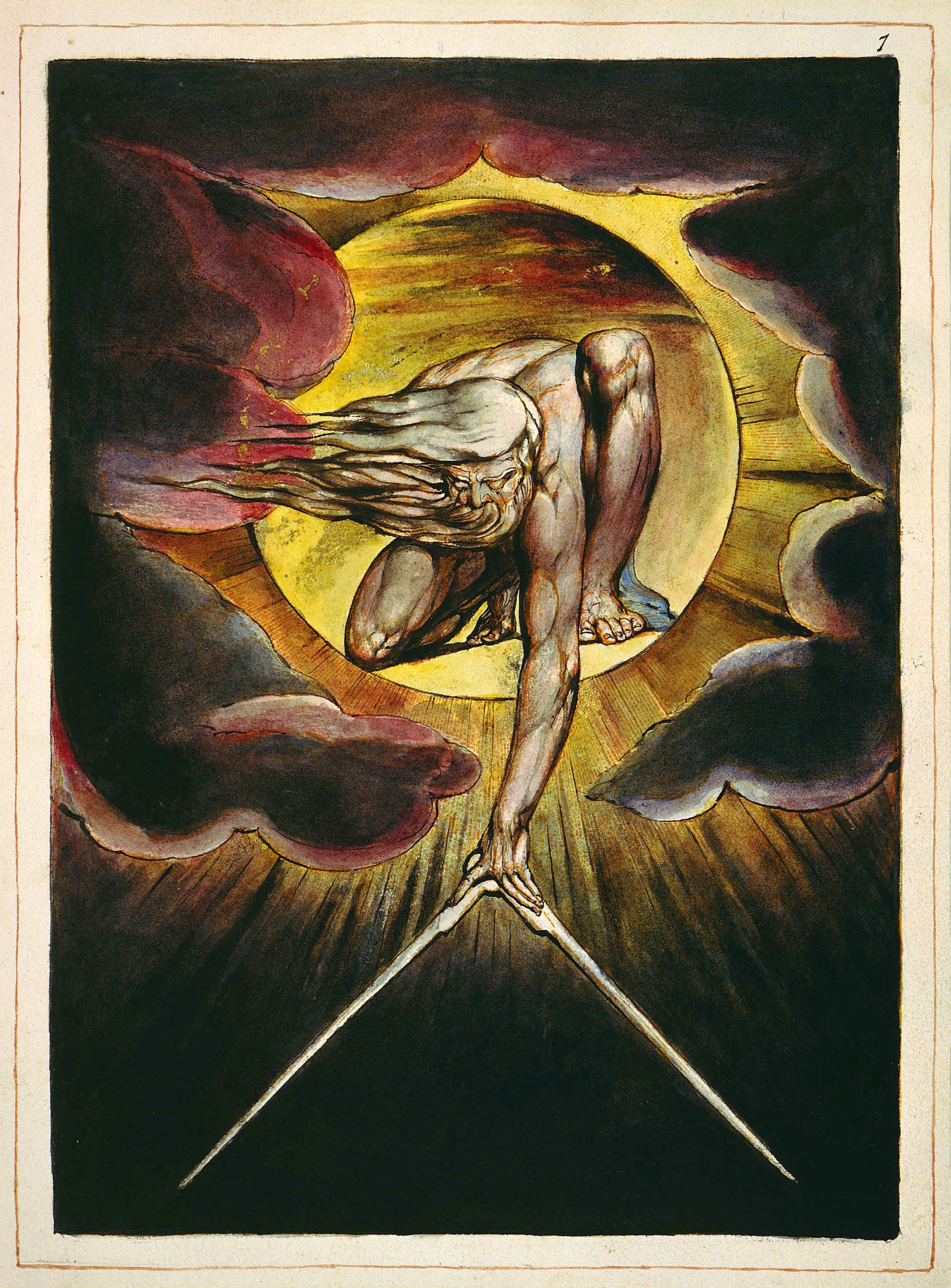
The Wikimedia Commons file record for Europe a Prophecy copy K, plate 01 gives a useful source anchor for the local reproduction. Blake's frontispiece, often known as "The Ancient of Days," makes measurement feel mythic: the compass is an instrument, a symbol of order, and a theatrical gesture of creation.
That tension reappears in diagrams, maps, engineering drawings, interface grids, data graphics, and the geometry of book pages. The image belongs near print, books, bookbinding, symbols, and design, not only near "Romantic art."
Looking Tags
Permalink to Looking TagsArt entries should carry more than style labels. Useful tags include medium, subject, symbol, period, place, collection, technique, reproduction method, object type, display context, and the kind of attention the work trains. A Blake print belongs near books and print. Dali's hypercube painting belongs near mathematics, symbols, and visual theology.
This is the practical bridge between art history and the compendium graph: the work is not only "surrealist," "religious," or "beautiful." It is a bundle of visual, material, symbolic, mathematical, historical, and institutional relationships.
Art As Infrastructure
Permalink to Art As InfrastructureArt helps a culture remember what it considers sacred, beautiful, dangerous, comic, noble, forbidden, useful, or strange. It also trains technical perception. Diagrams, icons, maps, charts, interfaces, book pages, scientific illustrations, product images, album covers, and stage visuals all borrow from the older problem of arranging visual attention.
This is why data visualization, maps, print, photography, music, design, and bookbinding sit near art in the graph. They are different uses of surface, sequence, scale, rhythm, symbol, and embodied perception.
Working Taxonomy
Permalink to Working Taxonomy- Icon and symbol: images that compress an idea into a recognizable mark.
- Material surface: paper, canvas, pigment, ink, plate, screen, textile, light, projection, object, or code.
- Composition: the geometry of attention inside a frame, page, room, stage, or interface.
- Reproduction: engraving, lithography, photography, print, scan, screen capture, cast, edition, and archive.
- Performance: gestures, timing, bodies, sound, costume, stage, audience, and documentation.
- Provenance: who made the work, where it moved, what copies exist, and how the record can be trusted.
- Interpretation: the living layer of criticism, memory, influence, ritual, identity, and personal encounter.
Digital Collections
Permalink to Digital CollectionsDigitized collections make art searchable, comparable, citable, and linkable. They also introduce a second object: the digital surrogate. A museum record may describe the work; an image file may describe a reproduction; a IIIF manifest may describe tiles and metadata; a local page may describe why the work matters in a specific knowledge system.
Good art metadata includes maker, title, date, medium, dimensions, location, rights, accession number, subject tags, provenance, related works, source URL, and image-rights context. The Getty Art and Architecture Thesaurus and broader Getty Vocabularies are useful because cultural objects need controlled names for materials, techniques, people, places, and work types.
The goal is not to make the compendium a museum database. The goal is to make visual notes interoperable enough that a reader can move from artwork to maker, symbol, medium, collection, period, reproduction, and related compendium thread without losing evidence.
Digital Image Hygiene
Permalink to Digital Image HygieneWhen a local image is used, the page should preserve source context nearby: original collection URL when available, rights or public-domain status, artist, title, date, and why the image appears in the compendium. File names should stay stable, descriptive, and close to the actual object title. Local assets are presentation files, not proof by themselves.
For rendered pages, images need alt text that describes the work rather than merely repeating the file name. For graph use, the image asset should point back to the artwork record, not become the record itself. A future media node should be able to say: this file depicts this work, comes from this source, was used on this page, has this local path, and carries this rights note.
Provenance And Rights
Permalink to Provenance And RightsGood art records should distinguish what is known from what is attributed, copied, restored, disputed, or inferred. A title may be modern. A date may be approximate. A work may exist in several editions or states. A scan may have one rights status while the underlying object has another.
For compendium work, that means linking to collection records when possible, naming uncertainty directly, avoiding unsupported influence claims, and keeping image files close to source metadata. The goal is not only a pleasant gallery; it is a durable web of objects, claims, media, and evidence.
Interpretation Discipline
Permalink to Interpretation DisciplineArt interpretation should stay vivid without becoming ungrounded. A useful interpretation says what feature of the work supports the reading: pose, color, composition, material, symbol, title, inscription, collection note, artist statement, exhibition context, or later reception.
Interpretation should also preserve uncertainty. "This resembles" is not the same as "this influenced." "Often titled" is not the same as "originally titled." "Attributed to" is not the same as "created by." Those distinctions matter for semantic web data and for ordinary reader trust.
Work, Image, And Object
Permalink to Work, Image, And ObjectA durable art record separates at least three things:
- the intellectual or cultural work being discussed;
- the physical object or event that instantiates it;
- the image, scan, photograph, print, cast, file, or page that represents it.
Those layers often share a title, which is why they are easy to collapse. A painting in a museum, a public-domain photograph of that painting, a cropped thumbnail on a web page, a catalogue essay, and a local compendium note are related but not interchangeable. The title may refer to all of them in casual language, while the graph should keep them distinct enough to answer provenance, rights, medium, and evidence questions.
This matters most when the same work has multiple states, copies, editions, restorations, photographs, or contested attributions. A Blake plate may be part of a specific copy of a printed book. A photograph may record a sculpture after a conservation treatment. A painting may have a modern title, an older exhibition title, and a collection identifier. Treating those as one record makes search feel simpler at first and less trustworthy later.
Collection Interoperability
Permalink to Collection InteroperabilityArt metadata becomes more useful when it can travel between local notes, museum records, IIIF manifests, linked-data graphs, catalogues, and image archives. A practical interoperability pattern is to keep stable identifiers close to human description: accession number, source URL, Wikidata item, authority record, IIIF manifest, local asset path, and page-level interpretation.
Semantic web systems such as CIDOC CRM and Linked Art are useful not because every local note needs museum-grade ontology modeling, but because they teach the right separations: person, group, production event, object, image, subject, place, period, collection, rights statement, and statement source. The compendium can stay lightweight while still borrowing those distinctions.
When an art note points to data sources, it should say what kind of source is being used. A museum collection record is evidence for attribution, dimensions, medium, accession, and current holding. A Wikimedia Commons file page is evidence for a specific digital reproduction and license context. A scholarly essay may be evidence for interpretation or reception. The source kind is part of the claim.
Knowledge Graph Role
Permalink to Knowledge Graph RoleUseful art edges include created_by, attributed_to, held_by, depicts, uses_symbol, made_with, printed_by, copied_from, edition_of, photographed_by, reproduced_as, influenced_by, exhibited_at, cited_by, interpreted_as, and rights_governed_by. Those relationships let art connect to history, symbols, maps, bookbinding, data visualization, data sources, and philosophy.
The graph should also separate visual resemblance from documented influence. Two images can look related without one causing the other. A good art record says which relationship is being claimed and what source supports it.
Display And Search Pattern
Permalink to Display And Search PatternAn art page should put the object before the interpretation. Show title, maker or attribution, date range, medium, dimensions, collection, rights note, source image, and visible features before asking what the work means. That order protects the reader from free-floating interpretation.
Useful search phrases include artwork, artist, visual culture, symbolism, provenance, collection record, material culture, art history, image rights, and interpretation. The graph can then connect those entry points to exact works, images, records, and claims.
Reader Workflow
Permalink to Reader WorkflowA useful art note should help a reader move from immediate perception to evidence. Start with the visible object: what is shown, what scale is implied, what medium is visible, and what details deserve attention. Then attach authority: collection record, catalogue identifier, image source, maker attribution, date range, and rights context. Only after that should the note make a larger interpretive claim.
This order is friendly to both readers and machines. The reader sees why the work matters without being asked to trust atmosphere alone. The knowledge graph can separate visible features, source-backed claims, and interpretive claims. Search can retrieve the work by title, maker, symbol, medium, collection, period, or related compendium thread. A future visual archive can then connect the page to exact image assets, not just to a loose theme called "art."
For local compendium use, the best art entries are therefore small dossiers: object facts, visual description, graph connections, source links, and a restrained interpretation that says what evidence supports it.
Status Labels For Art Claims
Permalink to Status Labels For Art ClaimsArt records need status labels because the same sentence can describe an object, an image, an attribution, a style, a subject, a collection fact, or an interpretation. Useful labels include object-fact, visual-description, collection-record, maker-attribution, workshop-attribution, subject-identification, iconographic-reading, provenance-claim, rights-statement, reproduction-note, conservation-note, exhibition-history, and interpretive-claim.
Those labels protect the page from treating every statement as equally settled. A museum accession number is a different kind of claim from a symbolic interpretation. A public-domain image license is not the same as rights to the physical object. A traditional title may not be the artist's title. A confident-looking catalogue record can still contain an attribution range, a date range, or a provenance gap.
For the compendium graph, art status labels connect directly to photography, print, bookbinding, history, symbols, and semantic web. A Blake plate, a museum painting, a scanned manuscript, and a design reference all need different node boundaries. The graph should say whether a relationship is visible resemblance, documented influence, shared symbol, copied edition, same physical object, same work, or same digital image.
The reader-facing benefit is clarity. A good art note can still be pleasurable and interpretive, but it should let readers see which facts are source-backed and which readings are thoughtful but contestable. That makes the page more useful to people and safer for search, structured data, and future image galleries.
The status labels also help with display. A thumbnail can introduce an object, but the article should not let the thumbnail replace title, maker, medium, scale, collection, rights, and source. Beautiful presentation is strongest when the reader can still inspect the record behind the image.
When multiple images represent one work, the page should say why each image exists. A full view, detail crop, conservation image, installation photograph, scan, plate, diagram, and generated preview all answer different questions. The graph should link them as representations, not duplicates. That is especially important for print, bookbinding, and manuscript material, where sequence, state, paper, binding, and reproduction method can change interpretation.
Search should also respect these differences. A reader looking for a symbol, medium, artist, collection, movement, rights status, or visual motif should land on a record that distinguishes object fact from interpretation. That is how an art page can feel visual and still behave like a trustworthy reference page.
The maintenance question for art is usually provenance: what source would change the title, attribution, date, medium, rights, collection, or interpretation? Keeping that question visible makes future updates additive rather than mysterious.
That is also a typography and layout concern. If the page displays the image beautifully but hides the record trail, the design has made trust harder; the best presentation lets the reader enjoy the work and inspect the evidence.
Failure Modes
Permalink to Failure Modes- Treating a reproduction as if it were the original work.
- Keeping beautiful images without source, rights, title, or collection context.
- Collapsing maker, workshop, publisher, printer, photographer, and owner into one vague "artist" field.
- Using style labels without medium, place, period, or evidence.
- Making interpretive claims that cannot be tied back to visible features or records.
- Forgetting that scale, surface, installation, frame, and sequence can change meaning.
Reference Sources
Permalink to Reference Sources- The Met collection record for Crucifixion (Corpus Hypercubus)
- Wikimedia Commons: Europe a Prophecy copy K, plate 01
- Tate: William Blake
- Getty Vocabularies
- Getty Art and Architecture Thesaurus
- Europeana
- IIIF Presentation API 3.0
- IIIF Image API 3.0
- Linked Art
- CIDOC CRM
- Library of Congress preservation science projects
Related Compendium Threads
Permalink to Related Compendium Threads- Photography for mechanical and computational image capture.
- Print for reproducible visual culture, editions, plates, and impressions.
- Symbols for compressed meaning and iconographic systems.
- Music for performance, notation, recording, and audio-visual culture.
- Design for applied visual decision-making and interfaces.
- Books and bookbinding for art as a sequenced, handled object.
- Maps for visual authority, territory, measurement, and place.
- Data Visualization for images that explain quantities and relationships.
- Semantic Web for linked cultural-object records.
- Mining History, Manuscripts, and Archaeology for provenance, interpretation, and cultural context.